Egg sizes chart: weights from peewee to jumbo
US eggs come in six USDA sizes, from peewee to jumbo, set by the minimum weight of a dozen. A large egg averages 2 oz (56.7 g) in the shell, a jumbo 2.5 oz (70.9 g) and a peewee 1.25 oz (35.4 g).
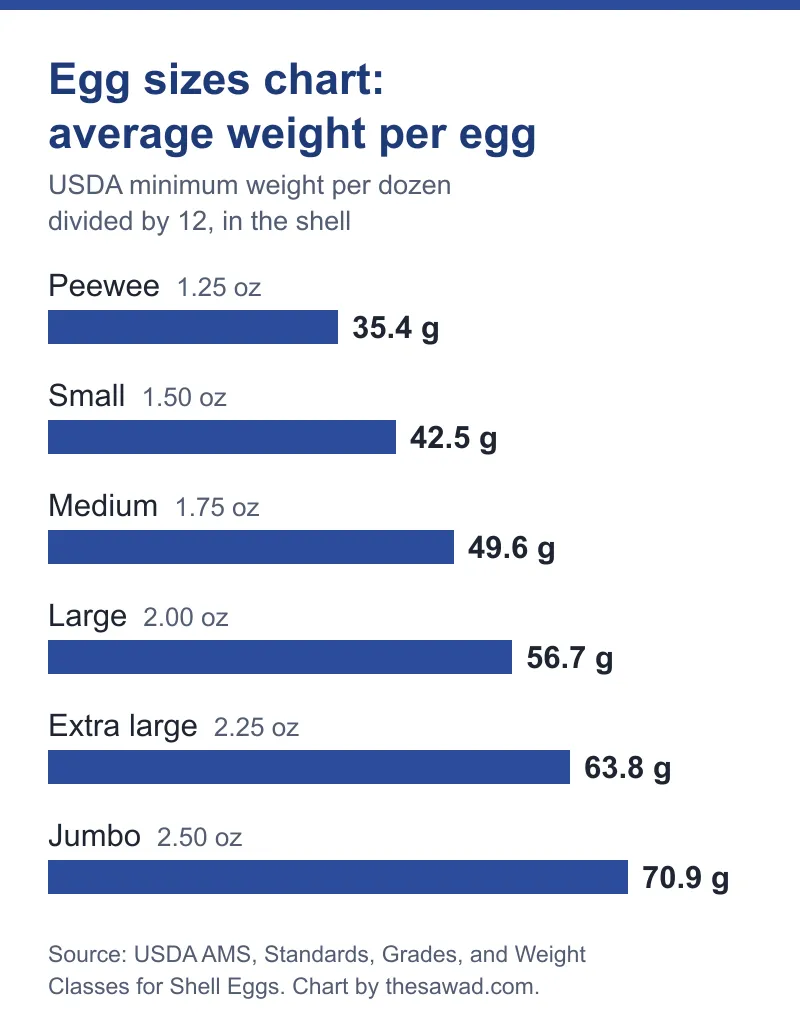
The sizes come from the USDA Agricultural Marketing Service's weight classes for shell eggs. Each class is a minimum net weight per dozen, so we divide by 12 to get the average egg. The chart below also gives the time our egg boiling timer sets for each size.
Quick answer: what are the egg sizes and weights?
USDA egg sizes are set by the minimum weight of a dozen: peewee 15 oz, small 18, medium 21, large 24, extra large 27 and jumbo 30. Divided by 12, a large egg averages 2 oz (56.7 g) and a jumbo 2.5 oz (70.9 g). Each step up adds 0.25 oz, about 7.1 g, to the average egg.
Key takeaways
- The six USDA sizes are peewee, small, medium, large, extra large and jumbo.
- A size is a minimum weight for the whole dozen, so single eggs in one carton vary.
- A large egg averages 56.7 g in the shell, and each size step adds about 7.1 g.
- Bigger eggs take longer to cook: from the fridge, a runny yolk takes 6:30 for a large egg and 7:30 for a jumbo.
Egg sizes chart with weights and boiling times
| Size | Minimum per dozen | Average egg | Average egg | Runny yolk | Jammy yolk | Firm yolk |
|---|---|---|---|---|---|---|
| Peewee | 15 oz | 1.25 oz | 35.4 g | 4:50 | 5:30 | 9:30 |
| Small | 18 oz | 1.50 oz | 42.5 g | 5:20 | 6:20 | 10:40 |
| Medium | 21 oz | 1.75 oz | 49.6 g | 6:00 | 7:00 | 11:50 |
| Large | 24 oz | 2.00 oz | 56.7 g | 6:30 | 7:40 | 13:00 |
| Extra large | 27 oz | 2.25 oz | 63.8 g | 7:00 | 8:10 | 14:00 |
| Jumbo | 30 oz | 2.50 oz | 70.9 g | 7:30 | 8:50 | 15:10 |
How the USDA egg sizes work
The USDA weight classes set a minimum net weight for a dozen eggs in the shell. A carton labeled large must weigh at least 24 oz for 12 eggs. One egg can weigh more or less than 2 oz, as long as the dozen reaches the minimum. That is why the chart gives an average egg and not an exact one.
The steps are even: each size needs 3 oz more per dozen than the one below it. Divide by 12 and each step is 0.25 oz per egg. In grams, that is 0.25 x 28.35 = 7.09 g.
How do you swap egg sizes in a recipe?
Match the total weight. Three large eggs average 6 oz (170.1 g) in the shell, which is the same as 3.4 medium eggs, 2.7 extra large or 2.4 jumbo.
| Large eggs in the recipe | Total weight | Small | Medium | Extra large | Jumbo |
|---|---|---|---|---|---|
| 1 | 2 oz (56.7 g) | 1.3 | 1.1 | 0.9 | 0.8 |
| 2 | 4 oz (113.4 g) | 2.7 | 2.3 | 1.8 | 1.6 |
| 3 | 6 oz (170.1 g) | 4.0 | 3.4 | 2.7 | 2.4 |
| 4 | 8 oz (226.8 g) | 5.3 | 4.6 | 3.6 | 3.2 |
Round to the nearest whole egg for everyday cooking. When the amount matters, as in a custard or a cake, weigh the eggs in their shells on a kitchen scale and match the total in the table.
Do egg sizes change the boiling time?
Yes. The heat has to reach the center of the yolk, and a bigger egg has farther to go. Our timer starts from America's Test Kitchen's time for a large egg: 6 1/2 minutes for a runny yolk. It scales that time for the other sizes with the Williams cooking formula, which works from the egg's weight. That is how a jumbo comes to 7:30 and a peewee to 4:50.
Eggs at room temperature and kitchens at altitude change the clock too. The egg boiling timer adjusts for size, starting temperature and elevation together.
For safety, the FDA advises cooking eggs until the yolk and white are firm. A runny or jammy yolk does not reach that point, so choose firm for anyone who should avoid undercooked eggs.
Frequently asked questions
How much does a large egg weigh?
2 oz (56.7 g) on average in the shell, from the USDA minimum of 24 oz per dozen.
What is the biggest egg size?
Jumbo: at least 30 oz per dozen, which averages 2.5 oz (70.9 g) per egg.
What is the smallest USDA egg size?
Peewee: at least 15 oz per dozen, which averages 1.25 oz (35.4 g) per egg.
How many medium eggs equal 2 large eggs?
About 2.3 by weight. Use 2 medium eggs plus a spoonful of a third beaten egg, or weigh them to match 4 oz (113.4 g).
Are all eggs in a carton the same size?
No. The size sets a minimum weight for the dozen, so single eggs can weigh a little more or less than the average.
Does egg size change how long to boil eggs?
Yes. From the fridge at sea level, a runny yolk takes 4:50 for a peewee, 6:30 for a large egg and 7:30 for a jumbo.
Conclusion
Read the size on the carton, swap sizes by weight, and set the boiling time for the eggs you have. The chart covers all six USDA sizes, and the egg boiling timer does the timing for any of them. For breakfast recipes that put your eggs to use, see Healthy Breakfast Cookbook or the rest of the TheSawad cookbooks.
Sources
- USDA Agricultural Marketing Service, United States Standards, Grades, and Weight Classes for Shell Eggs, AMS 56, section 56.218 (read 8 October 2026): minimum net weight per dozen for each size.
- America's Test Kitchen, Soft-Boiled Eggs (read 8 October 2026): 6 1/2 minutes for large eggs from the refrigerator, lowered into boiling water and covered.
- US Food and Drug Administration, What You Need to Know About Egg Safety (read 8 October 2026): cook eggs until the yolk and white are firm.