How much protein in an egg: 6.3 g in a large one
A large egg has 6.3 g of protein, by USDA FoodData Central. The white holds 3.6 g of it and the yolk 2.7 g.
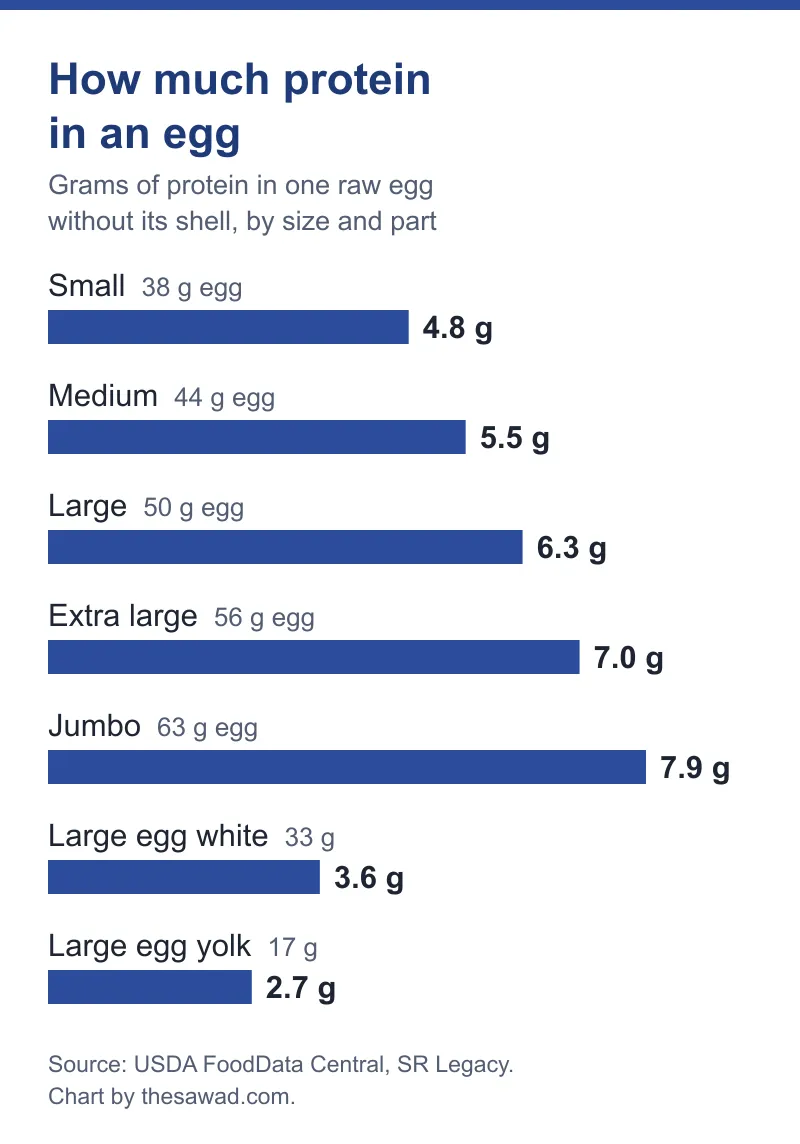
Every number here comes from USDA FoodData Central, the SR Legacy records for raw and cooked eggs. We multiply each record's protein per 100 g by its portion weight for one egg. A large egg is 50 g x 12.56 g per 100 g = 6.28 g. The record numbers are in the sources at the end.
Quick answer: how much protein is in an egg?
A large egg has 6.3 g of protein, by USDA FoodData Central. The white holds 3.6 g and the yolk 2.7 g. Egg size changes the total: a small egg has 4.8 g and a jumbo 7.9 g. Cooking does not change the grams, but cooked egg protein is easier to digest.
Key takeaways
- One large egg: 6.3 g of protein and 72 calories, from a 50 g egg without its shell.
- The white has 57 percent of the egg's protein, 3.6 g, for 17 calories.
- The yolk has more protein per gram than the white, 15.9 g per 100 g against 10.9 g, but it weighs half as much.
- Boiled, poached and fried large eggs all land between 6.1 g and 6.3 g of protein.
- Three large eggs give 18.8 g of protein; five give 31.4 g.
How much protein in an egg, by size
| Size | Egg weight | Protein | Calories | Fat |
|---|---|---|---|---|
| Small | 38 g | 4.8 g | 54 | 3.6 g |
| Medium | 44 g | 5.5 g | 63 | 4.2 g |
| Large | 50 g | 6.3 g | 72 | 4.8 g |
| Extra large | 56 g | 7.0 g | 80 | 5.3 g |
| Jumbo | 63 g | 7.9 g | 90 | 6.0 g |
| 1 cup of whole egg (4.86 large) | 243 g | 30.5 g | 348 | 23.1 g |
The protein grows with the weight, because every size has the same 12.56 g of protein per 100 g. Each step from small to jumbo adds about 0.7 g of protein.
Protein in the egg white and the yolk
| Part of a large egg | Weight | Protein | Calories | Fat | Protein per 100 calories |
|---|---|---|---|---|---|
| White | 33 g | 3.6 g | 17 | 0.1 g | 21.0 g |
| Yolk | 17 g | 2.7 g | 55 | 4.5 g | 4.9 g |
| Whole egg | 50 g | 6.3 g | 72 | 4.8 g | 8.8 g |
Gram for gram, the yolk is richer in protein than the white: 15.9 g per 100 g against 10.9 g. The white still carries more protein per egg because it weighs twice as much. Per calorie the white wins by far, with 21.0 g of protein per 100 calories against 4.9 g for the yolk. That is why egg whites show up in high protein, lower calorie meal plans.
A cup of liquid egg white, 243 g, has 26.5 g of protein, the same as about seven large egg whites.
Does cooking change the protein in an egg?
Not the grams. USDA's cooked egg records give one large egg 6.3 g of protein hard-boiled, 6.3 g fried, 6.3 g poached and 6.1 g scrambled. The small differences come from the separate egg samples behind each USDA record.
| Large egg, cooked | Portion weight | Protein | Calories |
|---|---|---|---|
| Hard-boiled | 50 g | 6.3 g | 78 |
| Poached | 50 g | 6.3 g | 72 |
| Fried | 46 g | 6.3 g | 90 |
| Scrambled | 61 g | 6.1 g | 91 |
What cooking does change is how much of the protein your body takes up. In a 1998 study in the Journal of Nutrition, Evenepoel and colleagues fed labeled egg protein to five people. They measured a true ileal digestibility of 90.9 percent for cooked egg protein and 51.3 percent for raw. The study was small, but it is a reason to cook eggs rather than drink them raw. The FDA also advises cooking eggs until the yolk and white are firm, for safety.
How many eggs for 20 or 30 grams of protein?
Divide your protein goal by 6.3 g per large egg. For 20 g, that is 3.2 large eggs; for 30 g, 4.8 eggs.
| Large eggs | Protein | Calories | Egg whites only | Calories |
|---|---|---|---|---|
| 1 | 6.3 g | 72 | 3.6 g | 17 |
| 2 | 12.6 g | 143 | 7.2 g | 34 |
| 3 | 18.8 g | 215 | 10.8 g | 51 |
| 4 | 25.1 g | 286 | 14.4 g | 69 |
| 5 | 31.4 g | 358 | 18.0 g | 86 |
| 6 | 37.7 g | 429 | 21.6 g | 103 |
To reach 30 g with fewer calories, mix them: 2 whole eggs plus 5 whites give 30.6 g of protein for 229 calories. Our protein calculator works out how much protein you need in a day, and the TDEE calculator the calories.
Why the USDA large egg weighs 50 g
FoodData Central weighs the part of the egg you eat, without the shell. A carton of large eggs is graded by the weight of the dozen in the shell, which averages 56.7 g per egg, as our egg sizes chart shows. So use 50 g for nutrition and 56.7 g when you swap egg sizes in a recipe.
Frequently asked questions
How much protein is in 2 eggs?
12.6 g in 2 large eggs, with 143 calories.
How much protein is in 3 eggs?
18.8 g in 3 large eggs, with 215 calories.
How much protein is in an egg white?
3.6 g in the white of a large egg, with 17 calories.
How much protein is in a boiled egg?
6.3 g in a large hard-boiled egg, the same as a raw one.
Is the protein in an egg in the white or the yolk?
Both. In a large egg the white has 3.6 g and the yolk 2.7 g.
Are raw eggs better for protein?
No. They hold the same grams, but in a 1998 human study cooked egg protein was 90.9 percent digested against 51.3 percent for raw.
Conclusion
A large egg gives 6.3 g of protein, a little over half of it in the white. Count by size, cook the eggs, and use whites when you want more protein per calorie. For egg breakfasts to cook, see Healthy Breakfast Cookbook, and time your eggs with the egg boiling timer.
Sources
- USDA Agricultural Research Service, FoodData Central, SR Legacy, published April 2019 (pulled 10 October 2026). Raw records: Egg, whole, raw, fresh (fdcId 171287); Egg, white, raw, fresh (172183); Egg, yolk, raw, fresh (172184). Cooked records: Egg, whole, cooked, hard-boiled (173424); poached (172186); fried (173423); scrambled (172187). Each gives protein, calories and fat per 100 g and the portion weight for one egg.
- Evenepoel P, Geypens B, Luypaerts A, Hiele M, Ghoos Y, Rutgeerts P. Digestibility of cooked and raw egg protein in humans as assessed by stable isotope techniques. Journal of Nutrition, 1998, 128(10), 1716 to 1722 (read 10 October 2026): true ileal digestibility of 90.9 percent cooked and 51.3 percent raw.
- US Food and Drug Administration, What You Need to Know About Egg Safety (read 8 October 2026): cook eggs until the yolk and white are firm.